 i
History
Ambrosius Hugger, a brewer from the Black Forest, opened the first brewery in Poznań in 1844 on Wroniecka Street. His sons Julius and Alfons bought the plot at the corner of Półwiejska Street in 1876 and built the Hugger Breweries here. In 1918 the plant brewed almost 72,000 hectolitres of beer a year.
During the fighting for Poznań in 1945 the brewery was badly damaged. After the war it was nationalised, and in 1980 it was closed. The buildings decayed, and until 1997 only a small soft-drinks plant operated in them.
In 1998 the site was bought by the company of Grażyna Kulczyk. Before building started, performances were staged in the ruins, including Verdi's “Macbeth”, broadcast live on TVP2. The first part of the centre, the Atrium, opened on 5 November 2003, the Art Courtyard on 29 April 2004, and the second wing, the Passage, on 11 March 2007. Since 2015 the centre has had a different owner, but the works of art from Grażyna Kulczyk's collection have stayed in their places.
Architecture
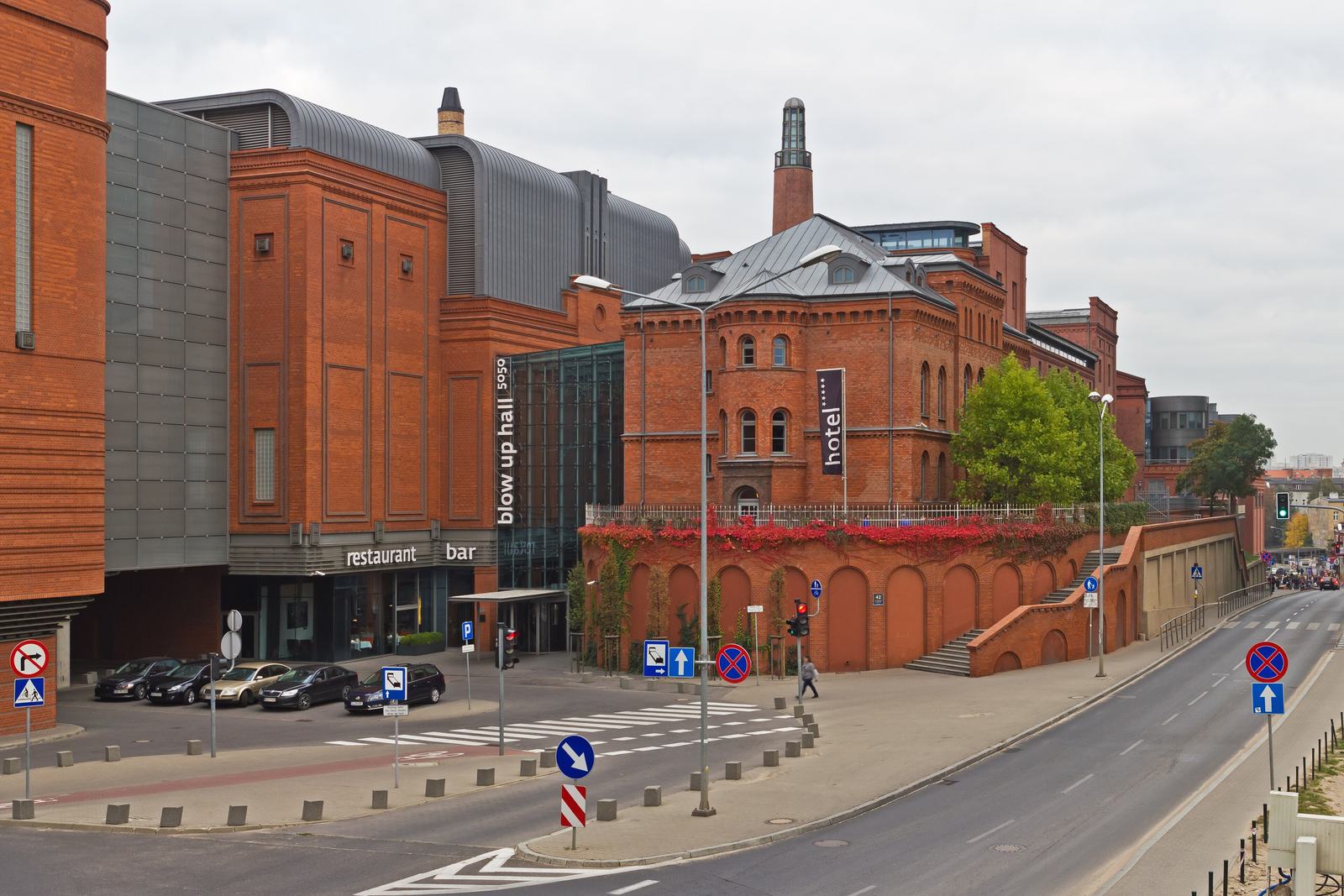
The oldest buildings, the Brewhouse, the Malthouse and the Drying House with its distinctive chimney, were built around 1890. They are in the arcaded style (Rundbogenstil), typical of factories of the time: red facing brick, round-arched windows and brick decoration.
The conversion was designed by the Poznań studio ADS (architects Piotr Barełkowski and Przemysław Borkowicz). Old walls were combined with modern steel and glass structures. The interior of the passages was designed by the stage designer Ryszard Kaja, the author of famous posters.
Stary Browar was among 20 buildings chosen for the exhibition “Poland. Icons of Architecture”, which presented the most important Polish architecture since 1989. It also received two Jan Baptysta Quadro awards for the best building of the year in Poznań, for 2003 and 2007. The International Council of Shopping Centers (ICSC) named it the best shopping centre in the world in 2005, and in 2008 it won again in the category of extensions.
After dark, look at the western façade of the Passage. It is the joint work of Studio ADS and the artist Adam Garnek: horizontal bands divide the glass block, and a light installation inside turns it into a shimmering, translucent ornament.
Works of art to see
“Thsuki-no-hikari” (Moonlight) by Igor Mitoraj in the Atrium: a monumental fragment of a human face modelled on an ancient sculpture. Poznań residents call it “the Mask” or simply “Mitoraj”, and it is one of the most popular meeting places in the city.
“Eros alato” (Winged Eros) and “Torso del lago” (Torso by the Lake), two smaller works by Mitoraj hung on the brick walls. Cracks and scratches on the perfect, classical bodies speak of transience.
“Opertus Lunula Umbra” (Hidden Shadow of the Moon) by the Korean artist U-Ram Choe: a kinetic sculpture suspended above the Chessboard. At set times it moves like a breathing animal, which is why Poznań residents call it “the Shrimp”.
“Conflict between Good and Evil” by Piotr Kurka: a black-and-white marble bench you can sit on. A raven sits on the white part. According to local legend, whoever strokes it will find it easier to solve life's problems.
“Citta Gentile” (Sensitive City) by Alessandro Mendini, the famous Italian designer: sculptures in the shape of letters of an alphabet he invented, made specially for Stary Browar.
“Henyo-Penyo Myomyonmyo” by the Japanese artist Mr., a pupil of Takashi Murakami. Regulars call this figure of a boy in jeans “Heniek”. The sculpture belongs to a series that refers to the attack on Hiroshima.
An installation by Leon Tarasewicz: green and yellow stripes that in 2003, for the 750th anniversary of Poznań, decorated the columns of the Grand Theatre. Today they hang in the Atrium, on one of the busiest routes in the building.
A bronze beer mug by Wojciech Kujawski, decorated with six figures, unveiled in 2007 for the opening of the Passage. At the unveiling two Guinness records were set: the largest beer mug in the world and the largest amount of beer drunk from a single vessel.
Exhibitions and tours
The Pop Culture Gallery, run by Stary Browar, is in the Courtyard. It shows exhibitions that combine fashion, art, design and technology. Past shows have included Andy Warhol, Björk, David LaChapelle, Gianni Versace and Ryszard Kaja. Check the current exhibition on the centre's website.
Stary Browar organises guided tours of its architecture, history and art collection. The date must be agreed with the information point at least two weeks in advance (informacja@starybrowar.com, tel. 61 859 60 50).
The Blow Up Hall hotel is part of the complex (entrance from ul. Kościuszki 42). In the hotel, the arte restaurant and the passage there are sculptures, installations and applied art from the owners' collection, created in cooperation with Polish artists. The arte restaurant is open daily 12:00–22:00 and b.bar 16:00–24:00 (table reservations: tel. 61 629 94 02).
Next to the centre is a historic park, a good place to rest after sightseeing.